Hello. This is the list of blogs I have commented on, and the comments I gave too :)
I fully agree with this article and found it to be a very interesting
read. I never really thought about it much, but when I read this article
I came to the realisation that the younger generations of today do seem
more accepting towards gay relationships compared to many of the older
generations.
It is the norm now for us to watch a tv programme
depicting gay couples or subtly hinting at gay relationships. I find
that it is nice that the older generations are slowly accepting gay
people in societies (though of course this is only a select few, and
even then it may just be indifference they feel towards this topic).
There will probably always be those who remain homophobic which I think
is quite sad, but people are entitled to their own opinions.
Your argument was very well thought out and convincing, and I especially enjoyed the video! :D
This was a very interesting topic to read about. I agree that people who
kill just for the fun of it should be given the death penalty, not a
"life sentence", that only means around 18 years. It is wrong for these
people to get away with such a thing. Although killing killers seems
rather old fashioned, I believe we should still carry out this law
today, for the sake of justice for the victim/s and the family/ies too.
This topic has been an interest of mine for some time, and I am glad to
have read your argument. It was very convincing and explanatory. I
especially agree with how religion affects some people, how they take
the rules they are meant to follow quite literally, and with disastrous
consequences as you mentioned previously when using those two shocking
examples. It is terrible to think that religion caused such horrible
outcomes to those people.
I think it is very unfair that
everyone has to abide by the rules of religion except for some (as in
your first picture examples (which were very clever and funny by the
way)) and how religion is very centered around money, which is rather
confusing.
I think that religion should definitely be a choice,
and not forced upon people. It may be hard for those born into religious
families to try and break away from that religion and still be accepted
by their family and friends just because they may not agree with the
rules and ideals.
So, I am going to remain atheist, and if
atheism is indeed a religion of its own, then I welcome the freedom to
choose what I believe in, whether it be aliens or a higher power.
I
enjoy the way you respect the religions of others, and I have to say I
found your topic very interesting to read! The examples you used were
very shocking but really great for drawing in the reader.
This was really, really interesting!
Hmmm, interesting topic. It was great to see both sides of the argument
shown here. However, I still thing of tagging when I think of graffiti,
which is a shame because real beautiful artworks of graffiti should be
the first thing I think of. It is disappointing to know there are those
people out there who just want to vandalize other people's property just
because they want to show they can.
An important thing that
graffiti artists should learn to make sure of is whether they are
allowed to paint all over a wall of a building, and that that is where
the majority of the problem lies; because ratepayers have to fork out
unreasonable amounts to cover the cost of removing it even though it is
not a typical eyesore, but because the owner of said wall or building
was not asked. Then again it would be hard for someone to ask a person
if they could graffiti a wall, because of what the common thought on
graffiti is.
In my hometown all of the generators around town are
graffitied over with amazing images (the newest one is of a tiger)
which I find to be acceptable. This is an example of getting permission,
because the council allowed this.
I think that it depends on the
type of graffiti to decide what is graffiti art, and what is just
unwanted scribble, and also whether it is ok to paint all over a wall.
Great topic, it was very enjoyable to read.
Wow I really enjoyed reading this blog, it really changed my views on
abortions. I was one of those people who thought that if women/girls
were fooling around and ending up pregnant, that they should have to
suffer the consequences of their actions. I hated that people could just
take away a innocent baby's life by having an abortion, and what I
thought was 'taking the easy way out'. However, you have made some
really good points, especially through saying about how the quality of
life for these unwanted and unplanned children would be lower than that
of a wanted child.
Great blog, and I am glad to have read it. It really made me think about my opinion of abortions. :)
Sunday, 12 May 2013

Thursday, 4 April 2013
Manga as a form of Literacy
The use of Manga in the classroom as an educational form of Literacy.
When translated into English, it means ‘whimsical
pictures’. There are many other names it goes by, such as manhwa, comics and
graphic novels, however, most people though would commonly refer to it as
manga.
Manga is said to date back in Japan as
early as the 18th century, and from then has continued on to being
the most popular form of novel in Japan. In 1995 statistics show manga as accounting for over
40% of sales of all book and magazine sales in Japan. It is well and truly one of the most popular
forms of reading material in the world. However, despite these facts manga is
yet to be introduced into schools as a way of teaching our young.
Although most of what is published in
America is for adults, manga are increasingly popular in America and other
countries with children being the majority of the readers. However, schools do
not approve of them as they should, even though manga can actually improve your
literacy more than a book may.
Why? Children, especially boys, are visual
learners, meaning they learn best when they look at images, pictures, colours
and maps. Manga and comics are of course is the obvious choice in these
scenarios because manga appeals to children, being made up of pictures and bright colours, with very
little reading involved.
For boys, manga is quite motivating because
the action and excitement happens within a few pages and boys don't generally like to wait for the story to develop. This can result in boys reading longer
stories in an attempt to discover more exciting stories.
Studies by a Japanese Psychologist, Jun Nakazawa,
shows that generally the older age group of the Year Ones to Year Sixes had an
increased understanding with age and expertise. One test was an eye-tracking
study comparing the eye movements of an "expert" versus a
"non-frequent" manga reader. The "non-expert" hovered more
on word balloons than images and had higher reading times. On the other hand,
the "expert" reader made "fewer useless eye movements" that
were smoother, in addition to a higher rate of skipping over more panels and
balloons. However, the expert also had higher story understanding recollection
than the non-expert, despite reading quicker and skipping elements.
Another aspect of the study was looking at the role
of manga in education. One fascinating find showed that frequent reading of
manga related to achievement in language arts (particularly sentence
comprehension) and a liking of social sciences, though "not significantly with liking for art class." Several studies on these issues also indicated
a higher level comprehension for learning from manga than from pure textual "novelised"
writing.
According to Brenda Pennella, a fifth grade teacher from Pennsylvania, manga aligns with reading comprehension skills:
We, as educators . . . have always known that reading is a series of skills: questioning, visualizing, inferring, predicting, connecting, and responding. . . . With graphic novels, the scaffolding necessary to build solid readers is in the architecture of the genre. The illustrations not only support the text; they are a part of the text. Students are given context clues within the subtle and sometimes not-so-subtle expressions, symbols, and actions of the characters within the story. Vocabulary is also supported within the illustrations and text. The framework or grid layout of this art form lends itself perfectly to the predicting strategies needed to reach higher-level understanding in reading comprehension.
Of course, not all manga is educational. There are people who believe manga and comics are reading material that should never even come near children, let alone classrooms. This is especially shown through Author Fredric Wertham’s bestseller, Seduction of the Innocent.

Published in 1954, this novel was a cause
of alarm for parents with claims warning that comics in America were causing
children to become delinquents, and comics became a scapegoat for children who
committed a crime similar to one depicted in a comic book, because it was the
comic book that “made them do it”. Wertham also accused comics to encourage
homosexual thoughts because Robin was always drawn with bare legs, that were
often left wide open and he appeared too attached only to Batman. Another claim
he made explained that comics gave children the wrong idea about the laws of
physics because superman could fly.
Wertham’s anti-comics crusade was the cause
of the enforcement of The Comics Code Authority.

-“No unique or unusual methods of concealing
weapons shall be shown.”
-“No comics magazine should use the
word horror or terror in its title.”
-“All characters shall be depicted
in dress reasonably acceptable to society.”
-“Females shall be drawn
realistically without exaggeration of any physical qualities.”
In 1971, the code was revised and relaxed
slightly, rewriting a few of the rules to, well, go with the times. For
example;
-“Healthy, wholesome lifestyles will be
presented as desirable. However, the use and abuse of controlled substances,
legal and illicit, are facts of modern existence, and may be portrayed when
dramatically appropriate.”
The Comics Code Authority finally ended its
56 year long run in February 2011, when the last two publishing companies using its services
finally ended the use of their serviced, despite the fact no one seemed to be
using it since as far back as 2009.
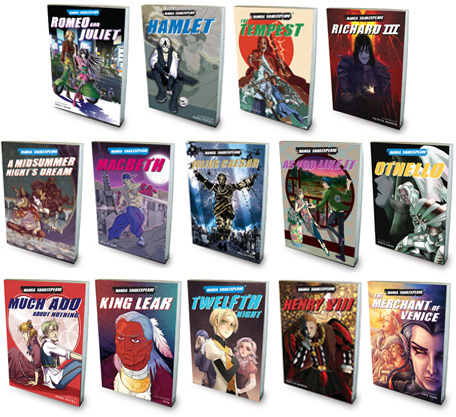
Luckily,
a few years ago a new group of people had come about promoting manga
specifically for use in classrooms; SelfMadeHero.

Manga
Shakespeare is a
series of graphic novel adaptations of William Shakespeare's plays.
Overall,
although some may not agree, I think manga is literature that deserves to be embraced
into society and into our classrooms. Studies have shown its effectiveness on
children and parents should not disregard this entertaining and educational
medium. Perhaps
most important, though, is that children are more likely to continue to read as
they grow up if they see reading as enjoyable – and what better than a manga
for teaching them that reading is fun? In fact, research shows that boys who
read manga are more likely to read other text-based material, and say they
enjoy reading more. So rather than rolling your eyes at your child’s choice of
reading material, encourage it; after all, if comics lead them to a lifelong
love of reading, then that can only be a good thing.
Reference list;
Allen, Kate.
Ingulsrud, John E.; Journal of Adolescent
& Adult Literacy (May 1, 2003). Retrieved April 26, 2013 from; http://business.highbeam.com/435378/article-1G1-101679714/manga-literacy-popular-culture-and-reading-habits-japanese
Association of
Comics Magazine Publishers; The Comics Code Authority. Retrieved on May 5, 2013
from; http://www.comicartville.com/comicscode.htm
Author unknown;
Graphic novels in the classroom. Retrieved on April 26, 2013 from; http://www.qrscanner.us/graphic-novels.html
Draper, D.
Comprehension Strategies Visualising & Visual Literacy. Retrieved on April
26, 2013 from; http://www.decd.sa.gov.au/northernadelaide/files/links/4_VisualisingBooklet.pdf
Nakazawa, Jun.
2002. Applied Developmental Psychology: Theory, Practice, and Research from
Japan (HC). Pages 32- 49. Retrieved on April 26, 2013 from; http://books.google.co.nz/books?id=L3dmZKStQ8kC&printsec=frontcover&dq=Applied+Developmental+Psychology:+Theory,+Practice,+and+Research+from+Japan+%28HC%29+jun+nakazawa&hl=en&sa=X&ei=HHiPUYfLEae9igLe8YAw&ved=0CDIQ6AEwAA
Natsume, F.
Japan’s Manga culture. Retrieved on April 26, 2013 from; http://www.jpf.go.jp/e/publish/periodic/jfn/pdf/jfn27_3.pdf
Pennella, B.
Graphic Novels: The POW!-er in the classroom! A Teacher’s Perspective.
Retrieved on April 26, 2013 from;
http://www.graphicnovels.brodart.com/teachers_perspective.html
Shwarz. G.
English Journal Volume 95, No. 6, (July 2006). Retrieved on April 26, 2013
from; http://www.jstor.org/discover/10.2307/30046629?uid=3738776&uid=2&uid=4&sid=21102204307301
Wertham, F.
Seduction of the Innocent, chapters 1-8. Retrieved on May 5, 2013 from; http://www.dreadfuldays.net/soti.html
Links:
<Struggling readers>
<Manga reading program U.S.>
<Inspire interests>
<Manga literacy popular culture> *
<A great example of manga in the form of literacy>
<Use of manga in the classroom>
<Comics in the classroom (seems helpful, has good links)>
<Literacy reading and writing skills>
<Graphic novel age>
<Expanding literacy through GN>
<A how to guide for teachers (helpful!)>
<Another teacher webpage>
<Americans say Oui to graphic novels>
<PDF>
<In classroom>
<Attack on comic books>
<Manga Shakespeare>
<The Comics Code Authority>
<The Comics Code Authority revised 1971>
<SelfMadeHero>
<Jun Nakazawa study>
Subscribe to:
Posts (Atom)